
Signs it's time
Most people start thinking about exterior door replacement for one of a few reasons. It's a drafty door you can feel from across the room. It sticks every winter. The bottom of the frame has gone soft. The lock feels flimsy. Or the door just looks tired next to everything else.
Sometimes a door can be fixed with new weatherstrip, a hinge adjustment or a rot repair at the jamb. A good contractor will tell you when that's enough.
Step one: measuring and checking the opening
The first visit is about more than size. We measure the rough opening, the wall thickness and the jamb depth. We note which way the door swings and which side the hinges are on. We also check the sill, the floor and the bottom of the jambs for rot. Water damage at the door threshold is common in our climate, and it changes the job.
Step two: choosing the door
The big choices are material, glass and style. In general terms:
- A fiberglass door resists dents and handles moisture well, and many can be stained or painted
- A steel door is strong and often a good value, but it can dent
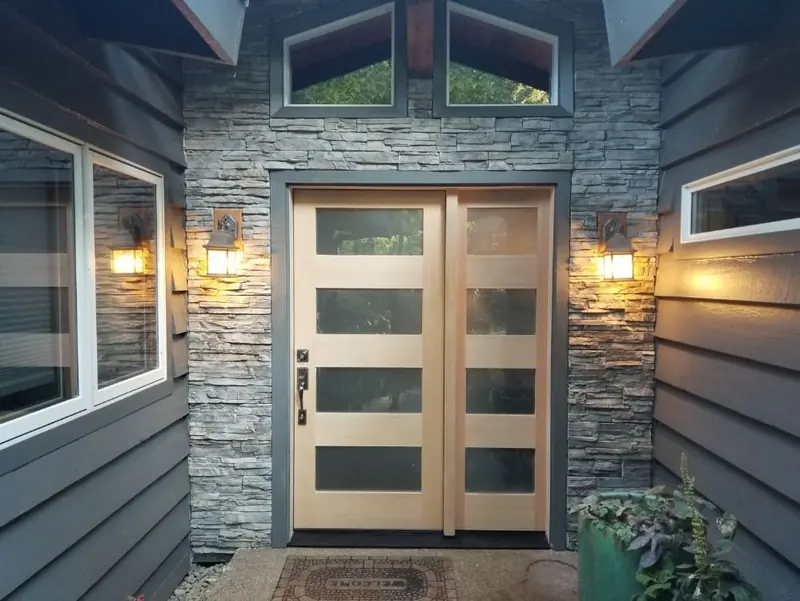
- A wood door looks beautiful and needs regular finish care to hold up to our weather
Then there's prehung or slab. A prehung door comes already mounted in a new frame. It's usually the better choice when the old frame is worn, out of square or rotting. A slab door is the door alone, fitted to the frame you already have. It can work well when that frame is solid.
If the door leads from the garage into the house, ask about it early. A garage entry door often has to meet fire-safety rules, and that narrows the choices.
Special-order doors can take a while to arrive. Ask about door lead time before you set your heart on a date.
The door is what you see. The flashing under it is what keeps the floor dry.
Step three: installation day
On a straightforward swap, door installation day usually goes like this:
- Floors and walkways get covered
- The old door, frame and trim come out
- The opening is inspected, and any rot in the sill or framing is repaired
- A sill pan or flashing goes in so water drains out, not into the floor
- The new door is set level, plumb and square with shims, then fastened to the framing
- Gaps around the frame are filled with low-expansion foam
- Trim goes back on inside and out
- The threshold, weatherstrip, lockset and deadbolt are installed and adjusted
A simple replacement often fits in a day. Rot repairs, custom trim or a change in the opening size can add time. A good crew plans so your house can be closed up and locked at the end of each day.
Step four: finishing
Some doors arrive pre-finished. Others need paint or stain once they're in. The exterior trim gets caulked and painted to keep water out. Ask whether finishing is part of the estimate or a separate step.
Step five: the walkthrough
Before the crew leaves, open and close the door with them. Check these things:
- It latches with a gentle push, without slamming
- The deadbolt slides all the way in without forcing it
- No daylight shows around the edges when it's closed
- The weatherstrip touches the door all the way around
- The threshold is snug to the bottom of the door
A quick check for the weatherstrip: close the door on a sheet of paper. If it slides out with no drag, the seal may need adjusting.
A note on bigger changes
Making the opening wider, adding sidelites or moving the door is a bigger project. It can involve new framing and may need a permit. Ask before you plan on it.
Triple SSS Construction replaces front doors, back doors, patio doors and garage entry doors around Portland and Gresham. We'll measure carefully, check what's behind the old frame, and leave you with a door that closes the way it should. Call (503) 781-2093 any time.
Exterior Doors